
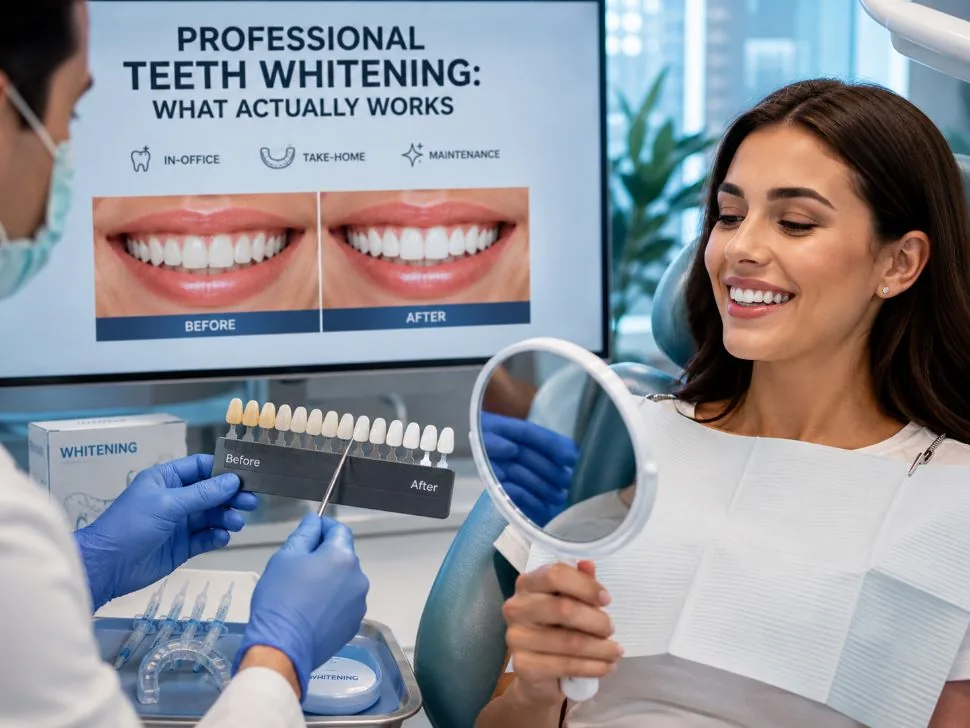
Walk into any drugstore and you'll see twenty whitening products promising "professional results." Open Instagram and you'll be served LED kits, charcoal pastes, whitening pens, and mail-order trays, each one claiming to do what the dentist does for a fraction of the price. Then you walk into a real cosmetic dental office and the price for "professional teeth whitening" sits between $400 and $1,500 depending on the protocol. The gap between the drugstore strip and the in-office session is real, but it's not where the marketing tells you it is — and the most common upcharge in the cosmetic-whitening market (the laser, the LED, the "blue light") is the part that the peer-reviewed evidence quietly says doesn't matter.
This guide walks through what professional teeth whitening actually means, what the different product tiers truly deliver in shade lift, what the active ingredient is doing versus what the marketing claims, what to ask in a consultation, what each option costs in 2026, when whitening makes sense as the first step of a bigger plan, and the red flags that should stop you. The goal is to give you the language to evaluate whitening on its evidence — not on the brochure.
One thing worth being upfront about: whitening is genuinely effective when done right and supervised. It is also one of the most over-marketed segments of cosmetic dentistry, and the upcharges between honest professional whitening and aggressively-priced in-office "spa" whitening can run several hundred dollars without changing the outcome. Knowing where the real value sits saves money and protects your enamel.
The Whitening Product Spectrum
"Whitening" covers a wide range of products and protocols, only some of which qualify as professional. The honest definition of professional whitening is: a peroxide-based whitening protocol either supervised by a licensed dentist using custom-fit trays, or delivered in-office using clinically appropriate concentrations with proper soft-tissue isolation. Everything outside that is over-the-counter or DIY, regardless of how the box describes itself.
| Product / Protocol | Active Ingredient | Honest Description |
|---|---|---|
| Drugstore whitening strips | Hydrogen peroxide 6-10% | Over-the-counter; modest effect on surface stain over weeks |
| Whitening toothpaste | Mild abrasives + low peroxide | Surface polish only; no real intrinsic shade change |
| LED at-home kits (mail-order) | Carbamide peroxide 10-22% | One-size trays + low-grade light; modest effect |
| Custom take-home tray system (dentist-prescribed) | Carbamide peroxide 10-22% | Professional whitening — supervised, custom-fit trays |
| In-office single-session whitening | Hydrogen peroxide 25-40% | Professional whitening — one chairside appointment |
| "Laser" or LED-activated in-office | Same peroxide + light source | Light adds little; the peroxide does the work |
| KöR / deep-bleaching system | Refrigerated high-strength peroxide + custom trays | Premium professional protocol for resistant cases |
The two protocols that earn the word "professional" without an asterisk are custom take-home trays and in-office chairside whitening. Both are dentist-prescribed, both use clinically appropriate peroxide concentrations, both involve soft-tissue isolation or a custom fit that protects gum tissue. Everything else is either an over-the-counter cosmetic with mild effect, or a DIY product whose results vary widely with no clinical supervision.
The brand names you'll see in dental offices — Zoom, Opalescence, KöR, Phillips Sonicare, GLO — are different delivery systems for fundamentally the same chemistry. Zoom and similar in-office systems pair high-concentration peroxide with a light source. Opalescence makes both at-home tray gels and in-office systems. KöR is known for deep-bleaching cases that other systems struggle with. The brand matters less than the protocol fit for your specific staining type.
What Professional Whitening Actually Achieves
The honest expectation for properly-supervised professional whitening is a 4 to 8 shade improvement on the Vita classical scale for typical extrinsic staining (coffee, tea, wine, tobacco, age-related yellowing). The Vita scale runs from B1 (lightest) to C4 (darkest) across 16 shades, and a 4-8 shade lift means jumping multiple positions on that scale — a visible, photographic difference that family and colleagues will notice.
For comparison, drugstore whitening strips average a 1-2 shade lift over their full multi-week cycle. The professional gap is real and measurable. But the gap isn't infinite — and what whitening does not do is just as important as what it does.
The implication: a complete whitening consultation includes a frank conversation about what your specific staining is, whether it's likely to respond, and what to expect realistically. A provider who promises "Hollywood white" without examining the staining type is selling a product, not assessing a case. The most resistant cases — old tetracycline staining, severe fluorosis, dark trauma teeth — sometimes whiten partially and then need bonding or veneers to finish. That's a planning conversation worth having before the first whitening session, not after.
Even on responsive cases, individual teeth respond differently within the same mouth. Canines (the pointed teeth) are typically darker than incisors and resist whitening more. The result after a whitening cycle is often a more uniform smile rather than every tooth shifting equally — which is usually the desired aesthetic outcome anyway.
The "Laser" / "LED Light" / "Blue Light" Claim
This is the single most over-marketed and least clinically supported piece of the whitening industry. Many in-office whitening protocols pair high-concentration peroxide with a light source — described as a laser, LED, halogen, or "activating" light — and the marketing implies the light is doing meaningful clinical work to accelerate or enhance the whitening reaction.
The peer-reviewed evidence on this is consistent and unflattering to the marketing. The light does not meaningfully accelerate whitening. Hydrogen peroxide and carbamide peroxide are the active ingredients; they release oxygen radicals that break down chromogen molecules in enamel. That chemistry happens at body temperature without any light input. Multiple randomized controlled trials, including studies cited in the Journal of the American Dental Association and Cochrane systematic reviews, have compared light-activated whitening to identical protocols without the light and found minimal-to-no clinical difference in shade outcome.
What the light does do reliably is generate heat. Heat slightly increases the rate of the peroxide reaction in vitro, but the temperature-rise needed for meaningful kinetic acceleration is uncomfortable for the patient and risks pulp sensitivity. In practice, the light component of in-office whitening is largely cosmetic theater — it makes the procedure feel high-tech, justifies the premium price, and gives the provider something visible to point to. The same outcome would be achieved by leaving the peroxide on for the same amount of time without the lamp.
The exception worth noting: some patients with extreme heat sensitivity or pulp issues are deliberately treated without light to avoid temperature rise. And custom-trained KöR-system protocols use a refrigerated peroxide + extended take-home tray approach with no light at all — and produce the most dramatic shade improvements available. The deepest professional whitening on the market is done without the light. That alone tells you what the light is actually contributing.
Five Questions for Any Whitening Consultation
These questions move the conversation from sales presentation to clinical fit. A confident provider welcomes them; a less-confident one redirects.
None of these are aggressive questions. They're the questions a thoughtful patient should ask. A provider who can answer all five fluently is doing whitening as part of clinical practice, not as an upsell add-on.
What Professional Whitening Costs in 2026
Pricing varies meaningfully by city, by protocol, and by whether the practice positions whitening as a premium spa-style service or as a standard hygiene-adjacent procedure. Here's the realistic 2026 U.S. range across the common scenarios.
| Whitening Option | Typical U.S. Range |
|---|---|
| Drugstore whitening strips (full course) | $30 – $60 |
| Whitening toothpaste (per tube) | $5 – $12 |
| Mail-order LED at-home kit | $80 – $250 |
| Custom take-home tray system (dentist-prescribed) | $250 – $500 |
| In-office single chairside session | $400 – $900 |
| "Laser" / LED-activated in-office (premium-positioned) | $700 – $1,200 |
| KöR deep-bleaching protocol (resistant cases) | $800 – $1,500 |
| Internal bleaching (single dark trauma tooth) | $300 – $700 |
| Maintenance refresher trays (annual) | $150 – $300 |
The top of the range sits in NYC, LA, Beverly Hills, Miami's South Beach corridor, and other premium cosmetic markets. The lower end shows up in Charlotte, Phoenix, Jacksonville, and most mid-tier metros. The clinical outcome on a typical responsive case is essentially the same across the price band — geography and practice positioning drive the variance, not the result.
For most patients, the highest-value path is custom take-home trays plus optional in-office boost, in that order. The custom trays handle the bulk of the shade lift over 2-4 weeks of compliant wear, the in-office session jump-starts the result if you want a faster initial change, and the same trays double as your annual maintenance vehicle for years. A patient buying both at typical pricing pays $600-1,300 once and then $50-100 in gel refills annually for indefinite maintenance. Compare to repeating $700 chairside sessions every 18 months without trays, which adds up to substantially more over a decade with weaker rebound control.
Sensitivity, Bleaching Damage, and What Not to Do
Done properly, professional whitening is safe — the FDA, ADA, and major dental associations have endorsed peroxide-based whitening at clinically appropriate concentrations for decades. Done improperly, especially with DIY products at unregulated concentrations, it can cause real damage. The risks worth knowing:
Tooth sensitivity
The most common side effect, affecting roughly half of whitening patients to some degree. Sensitivity is usually mild, transient (resolves within days of stopping treatment), and manageable with desensitizing toothpaste, fluoride application, or short breaks between whitening sessions. It is not a sign of damage. Severe persistent sensitivity is rare and almost always resolves once whitening is paused. A provider with a real sensitivity protocol — pre-treatment desensitizers, lower-concentration gel options, recovery breaks — manages this well.
Gum chemical burns
High-concentration peroxide on gum tissue causes white blanching and chemical irritation. In-office whitening uses gum-isolation barriers (a flowable resin painted onto the gums and cured) to prevent this. Custom take-home trays prevent it through proper fit. One-size-fits-all DIY trays are the most common cause of bleach burns because the gel leaks onto gums when the tray doesn't seal. Real burns are painful, can damage soft tissue, and are entirely preventable with proper protocol.
Over-bleaching and enamel translucency
Repeated whitening beyond the natural endpoint of your enamel — typically 6+ cycles per year over multiple years — can give teeth a chalky, translucent, slightly-blue appearance from the edges of the front teeth. The teeth look unnatural and lose the warm depth that real enamel has. This is over-bleaching, and it's not reversible. Most cosmetic dentists describe a healthy stopping point and don't continue bleaching past it. If a practice is willing to keep selling you whitening sessions indefinitely with no discussion of an endpoint, the practice is selling, not treating.
DIY peroxide concentration above safe range
The FDA and ADA endorse hydrogen peroxide concentrations up to 10% for take-home use and up to 40% for in-office supervised use. Imported or online whitening kits sometimes contain concentrations above these ranges, sometimes 50-60% peroxide marketed as "industrial strength" or "professional grade." These can damage enamel, cause severe sensitivity, and chemically burn soft tissue. If a kit doesn't disclose its peroxide concentration on the label, treat that as a reason not to use it.
Whitening as Step One of a Smile Makeover
For patients planning broader cosmetic work — veneers, bonding, crown restoration, or a comprehensive smile makeover — whitening should almost always come first in the sequence. The reason is straightforward: cosmetic restorations are color-matched at the time of placement, and the match is permanent. Veneers don't whiten later. Bonded composite doesn't whiten later. Crowns don't whiten later. Whatever shade those restorations are placed at is the shade they stay for the life of the restoration.
If you whiten after placing veneers, your natural teeth get brighter than the veneers, and the smile becomes mismatched. If you whiten before placing veneers, the dentist matches the veneer shade to your now-bright natural teeth, and everything stays in harmony. The rule of thumb in cosmetic dentistry is to bleach to your target shade, hold that shade stable for 1-2 weeks (which lets the color settle and the final shade fully express), and only then take the impressions or scans for veneer or bonding fabrication. Skipping that sequence is one of the most common avoidable problems in cosmetic dentistry.
The broader planning conversation matters too. If your goal is a comprehensive smile makeover with veneers, the whitening you do up front determines the final aesthetic ceiling. Brighter starting baseline, brighter ending result. A skilled cosmetic dentist plans this in the consultation, not as an afterthought after the veneer prep is already underway. For a complete walkthrough of how cosmetic treatments combine, see the smile makeover pillar guide; for the cost side specifically, the smile makeover cost breakdown covers what whitening adds to the comprehensive bundle.
Red Flags That Should Stop You
The whitening market has a few specific traps. Most are easy to spot if you know what to look for.
Online whitening kits with peroxide concentrations outside the FDA range — imported and direct-to-consumer kits sometimes ship 40-60% peroxide gel marketed as "ultra strength," well above the FDA's recommended 10% take-home maximum. These can damage enamel, burn gum tissue severely, and cause lasting sensitivity. Always check the peroxide percentage on the label. If it's not disclosed, don't use it.
"Whitening pens" that paint peroxide onto the tooth surface — most of these don't deliver enough contact time for the peroxide to penetrate and whiten meaningfully. They sell well as impulse purchases and produce minimal results. They're not dangerous, just largely ineffective.
Charcoal toothpaste and other "natural" whitening fads — activated charcoal is abrasive and removes surface stain temporarily, but the abrasiveness scratches enamel over long-term use without delivering any intrinsic whitening. The ADA has not endorsed any charcoal toothpaste. The trend is cosmetic-marketing, not clinical.
"Lifetime whitening" subscription packages — practices that sell unlimited whitening for a flat annual fee are economically incentivized to over-whiten. The healthy endpoint of whitening is finite; a model that profits from indefinite use isn't aligned with your enamel health.
"Same-day Hollywood smile" claims that combine whitening with same-visit veneers — see the sequencing discussion above. A practice willing to whiten and place veneers in the same visit is skipping the shade-stabilization window that determines whether the final result looks harmonious. The schedule is convenient; the outcome usually isn't optimal.
In-office whitening pricing that's 2-3x the local average without explanation — premium-positioned cosmetic practices sometimes charge $1,200-1,500 for what's clinically a single chairside session that runs $500-800 elsewhere in the same metro. The premium occasionally reflects genuine deep-bleaching protocols (KöR, multiple-session intense cases). More often it reflects positioning. Ask what's specifically different about the protocol that justifies the price.
How Smyleee Helps You Find a Whitening Provider
Smyleee maintains city-level Top 10 rankings specifically for teeth whitening providers in major U.S. metros, separate from our broader cosmetic dentist rankings. Each clinic is vetted on credentials, whitening-specific protocol signals (custom-tray prescribing, KöR or comparable system availability, sensitivity-management protocols), and aggregate patient feedback rather than raw review counts. The rankings flag practices that publish before-and-after whitening galleries and that offer custom take-home tray systems alongside in-office options.
Useful starting points if you want a curated whitening-specific shortlist:
- Top 10 Teeth Whitening Providers in New York City
- Top 10 Teeth Whitening Providers in Brooklyn
- Top 10 Teeth Whitening Providers in Los Angeles
- Top 10 Teeth Whitening Providers in San Diego
- Top 10 Teeth Whitening Providers in Miami
- Top 10 Teeth Whitening Providers in Charlotte
- Top 10 Teeth Whitening Providers in Phoenix
If whitening is the first step of a broader cosmetic plan rather than a standalone goal, our smile makeover pillar covers the planning sequence end-to-end, the smile makeover cost breakdown covers realistic budget ranges across treatment scopes, and the best veneer dentist guide covers picking a provider for the cosmetic-restoration phase that follows whitening. City-specific smile makeover guides are also published for New York, Brooklyn, Los Angeles, San Diego, Miami, Charlotte, and Phoenix.
Final Thoughts
Professional teeth whitening is one of the highest-leverage, lowest-invasiveness cosmetic procedures in dentistry. Done well, with custom trays and a sensible maintenance plan, it produces a visible 4-8 shade lift on most patients, costs a fraction of veneers or bonding, and preserves the natural tooth completely. It is also one of the most over-marketed segments of cosmetic dentistry, and the gap between honest professional whitening and aggressively-priced spa-style whitening is real money paid for marketing rather than outcomes.
The honest checklist is short. Pick a provider who prescribes custom-fit trays, can explain their peroxide concentration without hedging, has a written sensitivity protocol, and talks about maintenance from the first conversation. Ask whether the in-office light is justified by the price difference; if the answer is vague, the price difference probably isn't. If you're heading toward broader cosmetic work, do whitening first, hold the result for one to two weeks, then plan the veneers around the bleached shade. Skip the salon kiosks, skip the imported high-concentration kits, and don't assume a higher price tag means a better outcome.
Whitening done right is durable and worthwhile. Whitening done wrong wastes money, damages enamel, and produces results that don't hold up. The difference between the two isn't the brand of the gel or the color of the lamp — it's the planning around it.
Find a Custom-Tray, Mockup-Driven Whitening Provider
Browse Smyleee's curated, vetted directory of whitening-experienced cosmetic dentists across the U.S. — with verified credentials, sensitivity-protocol flags, and aggregate patient ratings.
Sources & References
- U.S. Food and Drug Administration — Teeth Whitening Product Safety
- American Dental Association — Tooth Whitening / Bleaching Patient Resources
- American Dental Association Health Policy Institute — Cosmetic Procedure Cost Data
- American Academy of Cosmetic Dentistry — Patient Resources & Provider Standards
- Cochrane Systematic Review — Light Activation in Tooth Whitening
- MetLife Oral Fitness Library — Cosmetic Dental Treatment Cost Reference
- GoodRx — Professional Teeth Whitening Cost Guide
- American Dental Association MouthHealthy — Whitening Patient Guide
- IRS Publication 502 — Medical and Dental Expenses (HSA / FSA Eligibility)