
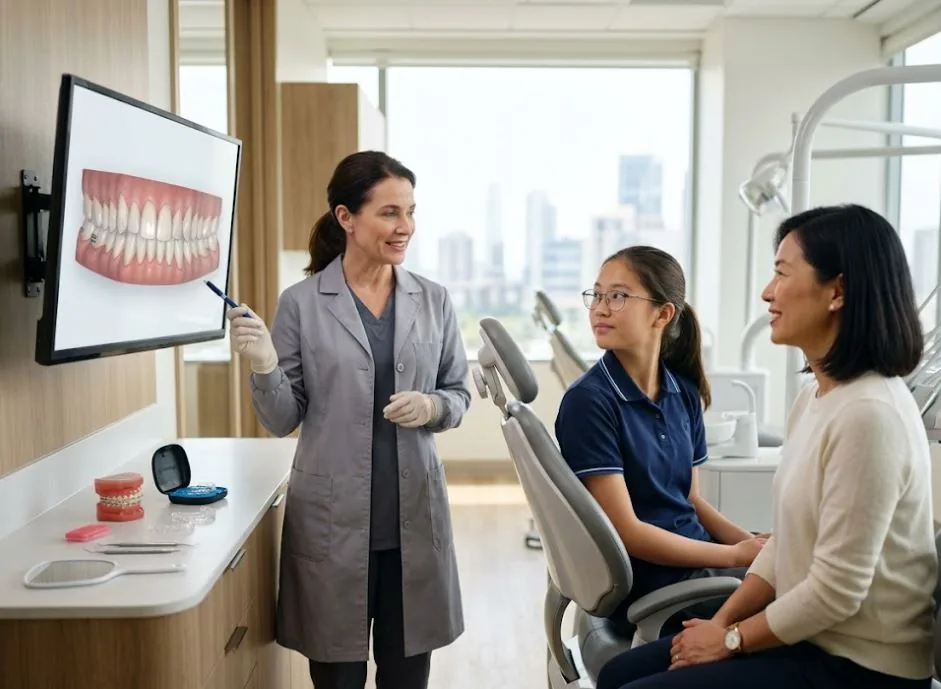
Search "top rated orthodontist near me" and you'll get a wall of clinics all using the same three words. Every practice is "top rated." Every reviewer is glowing. Every consultation is "free." What "top rated" should actually mean — and what most patients miss — is something concrete: a residency-trained provider with verifiable board credentials, real case volume, modern technology, and pricing that's transparent before you commit.
Orthodontics is one of the most upmarketed specialties in dentistry. The treatment is long (18 to 30 months on average), the cost is high ($3,500 to $8,500 for comprehensive care), and the visible commitment is enormous — your kid will wear braces in their school photos for two years, or you'll go through a decade of professional life with aligners. That combination of duration, expense, and visibility makes orthodontics fertile ground for marketing claims that sound great but don't actually mean anything.
This guide gives you the real markers of a top-rated orthodontist — the ones that hold up under scrutiny. We'll walk through credentials, the questions that actually surface a provider's quality, what each treatment type genuinely costs, how insurance and payment plans work, and the red flags that should make you walk out of a consultation. By the end, you'll be able to evaluate any orthodontist's "top rated" claim on the merits, not the marketing.
What "Top Rated" Should Actually Mean
The term gets thrown around so loosely that it's worth resetting. A genuinely top-rated orthodontist is not the practice with the most five-star Google reviews. Reviews are gameable, recency-skewed, and rarely reflect clinical outcomes — they mostly reflect front-desk friendliness and waiting-room ambiance. The real markers are a different set of things, and most of them are verifiable in two minutes online.
American Board of Orthodontics (ABO) certification — voluntary peer-reviewed certification beyond the basic license. Only about 32% of practicing orthodontists hold it. Not having it doesn't mean someone is bad; having it is a real signal of skill and case-quality scrutiny.
Case volume in your specific situation — an orthodontist who does 200 simple Invisalign cases a year may not be the best fit for a complex skeletal case requiring jaw surgery coordination. Conversely, the surgical-orthodontic specialist may not be the right value for your kid's straightforward Phase 2 braces case.
Modern technology in active use — intraoral 3D scanners (replacing goopy impressions), CBCT imaging for complex cases, treatment-planning software with real outcome simulation. Practices that still rely entirely on conventional impressions and 2D X-rays for everything aren't necessarily bad, but they're working with older tools.
Pricing transparency before any work — you should leave the consultation with a written, itemized treatment plan and total cost, not a sales pitch and an immediate "lock in today's price" offer.
None of these markers is a single make-or-break filter. The pattern matters more than any one item. A provider hitting 4 of 5 of these is meaningfully different from one hitting 1 of 5, even if the second has a flashier website and more reviews.
The Credentialing Landscape
Here's how the U.S. credentialing tiers actually break down, because the marketing terminology blurs them on purpose. Knowing which tier your provider sits in tells you almost everything about the depth of their training.
| Tier | Training | What They're Best For |
|---|---|---|
| General Dentist (no extra ortho) | 4-year DDS/DMD | Should refer out almost all real ortho cases |
| General Dentist with Invisalign certification | DDS/DMD + weekend or short course | Mild, cosmetic-tier alignment cases only |
| Orthodontist (residency-trained) | DDS/DMD + 2-3 year accredited residency | Full range of orthodontic cases |
| Board-Certified Orthodontist (ABO) | Above + voluntary peer-reviewed certification | Same scope; signals additional case-quality scrutiny |
| Surgical Orthodontist / Craniofacial Specialist | Above + further fellowship | Complex skeletal cases, jaw surgery coordination, cleft palate work |
Most patients are best served by a residency-trained orthodontist. ABO certification is a meaningful additional filter for difficult cases, second opinions, or anyone who simply wants the higher-credentialed option. General-dentist Invisalign should be reserved for genuinely mild cosmetic cases, where the case complexity matches the training depth.
Five Questions That Actually Surface Quality
Most orthodontic consultations follow a predictable script — exam, photos, recommendation, fee presentation. Patients rarely steer the conversation. These five questions, asked plainly, surface the things the script tends to skip.
None of these questions are aggressive or unusual. A good orthodontist welcomes them — these are the questions a thoughtful patient should ask, and a confident provider has solid answers ready. A defensive or rushed reaction to any of these is itself the answer.
Braces vs. Invisalign vs. Clear Aligners
The treatment-type decision matters less than picking the right provider. A residency-trained orthodontist will get you to a strong outcome with whichever option fits your case. But the differences between options are real, and you should understand them.
| Factor | Traditional Metal Braces | Invisalign / Clear Aligners | Ceramic Braces |
|---|---|---|---|
| Best for | Most cases, especially complex movements | Mild to moderate cases; adult preference for discretion | Same scope as metal; more visible-aware adults |
| Treatment time | 18-30 months typical | 12-24 months typical | 18-30 months typical |
| Visibility | Most visible | Nearly invisible | Less visible than metal; still bracketed |
| Compliance dependency | Low — fixed appliance | High — must wear 22 hrs/day | Low — fixed appliance |
| Typical U.S. cost | $3,500 – $7,000 | $4,000 – $8,500 | $4,500 – $8,000 |
| Hygiene | Harder — brackets trap food | Easier — remove to brush/floss | Harder — brackets trap food |
| Refinement | Wire/bracket adjustment | New aligner set ($500-1,500 typical) | Wire/bracket adjustment |
The biggest decision driver for adults is usually visibility. The biggest one for teens and kids is compliance — Invisalign requires actually wearing the aligners 22 hours a day, which not every teenager will reliably do. Discuss compliance honestly with your provider; a good orthodontist will recommend braces for a teen who's a known compliance risk, even if the family wanted Invisalign.
What Treatment Actually Costs in 2026
Cost varies by geography, provider tier, case complexity, and treatment type. Here's the realistic 2026 U.S. range across the common scenarios:
| Scenario | Typical Range |
|---|---|
| Phase 1 / early intervention (kids, ages 7-10) | $1,500 – $4,000 |
| Comprehensive teen braces | $3,500 – $7,000 |
| Adult metal/ceramic braces | $4,500 – $8,000 |
| Comprehensive Invisalign (full case) | $4,000 – $8,500 |
| Invisalign Express / Lite (mild cases) | $2,500 – $4,500 |
| Surgical-orthodontic case (jaw surgery + ortho) | $25,000 – $60,000+ |
| Retainers (per arch, post-treatment) | $150 – $700 |
The top end of these ranges sits in NYC, LA, San Francisco, and Boston. The lower end shows up in smaller metros with less rent overhead and dental-school presence — Birmingham, Charlotte, Phoenix, Jacksonville. The treatment outcome is essentially the same; the geography sets the price.
Insurance, Financing, and Payment Plans
Most dental insurance plans include a separate orthodontic lifetime maximum, distinct from the annual dental maximum. Typical lifetime ortho coverage runs $1,500 to $3,000 per insured family member, often with a 50/50 split (insurance pays half, you pay half) up to that ceiling. The lifetime max is a per-person cap — once it's used, no more ortho coverage on that policy for that patient.
Almost every orthodontic practice offers some form of in-house monthly payment plan, typically with no interest if paid within the treatment window (18-30 months). A typical structure: $500-1,500 down, then $150-300/month for the duration. Compare this against external financing (CareCredit, LendingClub Patient Solutions) — the in-house plan is usually a better deal because there's no interest exposure if you stay current.
For families enrolling more than one child, ask about sibling discounts. Most practices offer 5-10% off the second and subsequent siblings starting treatment. Combined with HSA/FSA dollars (orthodontic care is an eligible expense under both), the all-in cost is usually meaningfully lower than the sticker.
Red Flags That Should Stop You
The orthodontic market has a few well-known traps. Some are obvious in hindsight; some have caught a lot of patients in the past few years.
Mall kiosks and pop-up "consultation centers" — these exist primarily to funnel patients into a contract with a remote provider. The on-site staff are typically not orthodontists. Walk past them.
"$399 braces" or aggressive bait pricing — that price is almost always for the cheapest possible case scope (often just lower-arch alignment), excluding records, X-rays, retainers, and refinements. The all-in cost ends up matching or exceeding a normally-priced full case. Ask for the all-in number, in writing, before agreeing to anything.
Practices that won't share their orthodontist's name — corporate dental chains often advertise "orthodontists at every location" without naming who's actually treating you. You should know your provider's name and credentials before signing a contract.
"Lock in today's price" pressure at the consultation — orthodontic treatment is a 2-year commitment costing $5,000+. It is not an impulse purchase. Any provider pressuring same-day commitment is using a sales tactic, not a clinical one.
Refusal to provide a second-opinion-friendly treatment summary — a confident orthodontist gives you the records to take to a second-opinion consultation. One who tries to keep you locked in is signaling something about their own confidence in the case plan.
How Smyleee's Directory Helps
Smyleee maintains city-level Top 10 orthodontist rankings for major U.S. metros, with each clinic vetted on credentials, case-volume signals, technology, and aggregate patient feedback rather than raw review counts. The rankings explicitly surface board-certified providers and flag clinics offering payment plans.
Useful starting points if you want a curated shortlist instead of working through Google search results:
- Top 10 Orthodontists in New York City
- Top 10 Orthodontists in Los Angeles
- Top 10 Orthodontists in Miami
- Top 10 Orthodontists in Phoenix
- Top 10 Orthodontists in Charlotte
- Top 10 Orthodontists in Brooklyn
For specific treatment types — Invisalign-only providers, adult ortho specialists, pediatric programs — we publish dedicated guides covering how to find a top-rated Invisalign provider and choosing an adult orthodontist as a first-time adult patient. Pediatric guidance lives in the pediatric orthodontist guide.
Final Thoughts
"Top rated" is the most overused phrase in orthodontic marketing — and the most underdefined. The good news is that the markers that actually matter are public, verifiable, and easy to ask about: residency training, ABO certification, case volume, technology in active use, and pricing transparency. A provider who hits those marks is genuinely top rated whether or not their Google profile says so. A provider who scores low on those markers is exactly the kind of practice the term "top rated" was invented to disguise.
Spend an extra hour on the consultation phase. Ask the five questions. Get the cost in writing. Ask for case-similar before-and-afters. Walk out without committing if anything feels off. The next 18-30 months of your life — or your kid's school photos — depend on a decision that will outlast almost everything else about the choice. That decision deserves the time it takes to get right.
Find a Genuinely Top-Rated Orthodontist
Browse Smyleee's curated, credentials-vetted directory of orthodontists across the U.S. — with board-certification flags, payment-plan markers, and aggregate ratings.
Sources & References
- American Association of Orthodontists — Find an Orthodontist & Patient Resources
- American Board of Orthodontics — Board Certification Standards
- American Dental Association Health Policy Institute — Orthodontic Workforce & Cost Data
- U.S. Food and Drug Administration — Dental Aligner Safety Guidance
- Centers for Disease Control and Prevention — Division of Oral Health
- MetLife Oral Fitness Library — How Much Do Braces Cost?
- GoodRx — How Much Do Braces and Invisalign Cost?
- CareCredit — Orthodontic Financing Options
- Invisalign — Treatment Process Overview
- IRS Publication 502 — Medical and Dental Expenses (HSA / FSA Eligibility)