
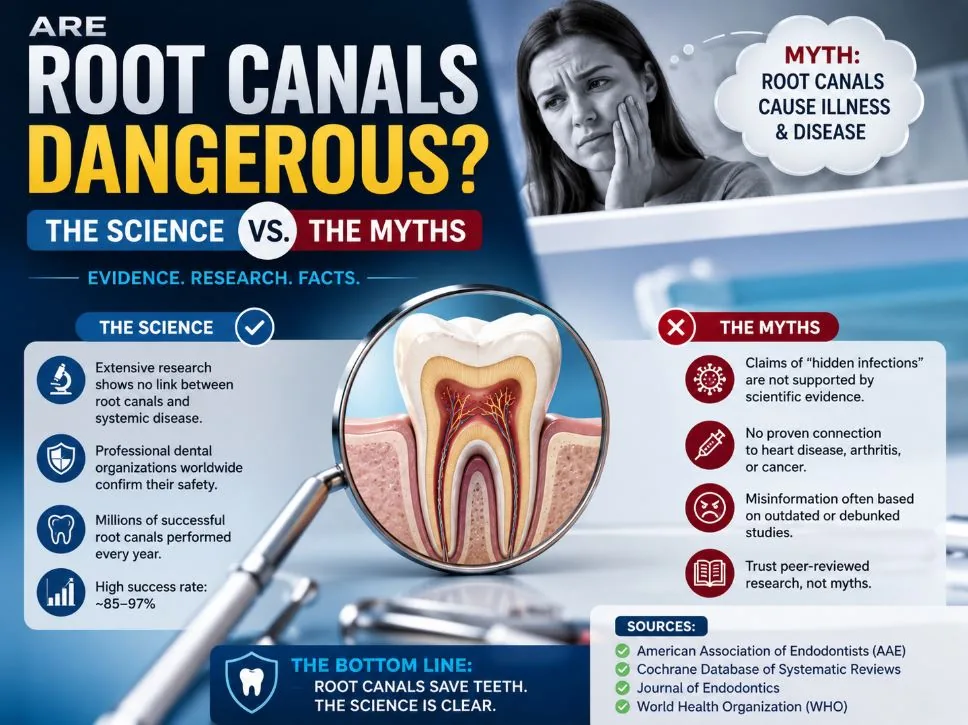
"Are root canals dangerous?" is one of the most-searched dental questions on the internet, and the reason isn't mysterious. A persistent strand of online content — viral documentaries, alternative-medicine blogs, social-media reels — claims that root-canaled teeth cause cancer, heart disease, autoimmune illness, and chronic systemic inflammation, and that the only safe response is to extract every endodontically treated tooth in your mouth. The claim has real persistence and real reach. It is also, by every credible measure of evidence, wrong. The premise of this post is straightforward: every claim about root canal safety made here cites a primary source, the evidence is presented honestly, and the conclusion follows from the sources rather than the other way around.
If you're reading this because you watched a documentary, encountered a relative quoting Weston Price, or found a wellness influencer telling you to extract your root-canaled molar before it gives you cancer, you are not stupid for taking the claim seriously. The information ecosystem that delivered it to you is sophisticated, emotionally resonant, and very good at sounding scientifically credible. The actual scientific literature is denser, less viral, and harder to assemble into a single clean narrative — which is precisely why the misinformation outcompetes it on social channels. This post is an attempt to put the actual evidence in one place, with citations, in language that respects both your intelligence and the rigor of the underlying research.
The short version, for readers who want it before the depth: there is no peer-reviewed evidence that endodontically treated teeth cause cancer, heart disease, autoimmune disease, or any other systemic illness. The pseudoscientific claim that they do traces back to a single 1920s researcher whose methodology was rejected by the dental research community by the 1950s and whose theory has been refuted continuously by subsequent population-level studies. The American Association of Endodontists, the American Dental Association, and the Centers for Disease Control all affirm that endodontic treatment is safe. The longer version, with sources, follows below.
The Origin: Weston Price and the 1920s Focal Infection Theory
To understand why the "root canals are dangerous" claim refuses to die, you have to understand where it started. Weston Price was a respected American dentist of the early 20th century — a real DDS, a serving research director for the National Dental Association in the 1910s and 1920s, and a careful observer in many domains of his work. In the 1920s he proposed what came to be known as the focal infection theory: the idea that a localized infection in one part of the body — particularly an endodontically treated tooth — could seed bacteria into the bloodstream and cause disease at distant sites, including arthritis, heart disease, kidney disease, and a long list of other ailments.
Price's most-cited experiments involved extracting endodontically treated teeth from patients with various systemic illnesses, then implanting those teeth (or fragments of them) under the skin of laboratory rabbits. When some rabbits developed illnesses resembling those of the original human patient, Price interpreted this as evidence that the treated teeth were the source of the systemic disease. The methodology was crude even by 1920s standards — there were no controlled comparisons against extracted healthy teeth, no sterile technique by modern definitions, no consideration that the rabbits' open wound sites would inevitably become infected with whatever oral bacteria were present, and no consideration that rabbit immune systems are not analogous to human immune systems for the purpose of inferring human disease causation.
For a brief period in the 1920s and 1930s, Price's theory drove a meaningful clinical fashion: the prophylactic extraction of healthy or treated teeth as a "cure" for arthritis and other chronic illnesses. Tens of thousands of teeth were extracted on the strength of the theory. Patient outcomes did not improve. By the late 1930s, follow-up clinicians had begun publishing case series showing that the wholesale extraction approach was failing to deliver the promised systemic benefits. The wave receded.
What the 1950s-Onward Research Actually Showed
By the 1950s, the focal infection theory had been thoroughly investigated and largely rejected by mainstream medicine and dentistry. A landmark 1951 editorial in the Journal of the American Dental Association reviewed two decades of accumulated data and concluded that there was no credible evidence that endodontic treatment or healthy teeth caused systemic disease. The Mayo Clinic published retrospective work in the same era showing no clinical benefit to tooth extraction for systemic illness. The American Dental Association formally retreated from the focal infection theory by the mid-20th century, and the dental literature redirected its attention to what actually does work — the developing standards of modern endodontic technique, the science of pulp biology, and the clinical outcomes that matter to patients.
Over the subsequent seven decades, the research has continued. Population studies, cohort analyses, systematic reviews, and direct experimental work in microbiology and immunology have repeatedly examined whether endodontic treatment is associated with any systemic disease. The methodology has gotten dramatically more rigorous than anything available in Price's era — large sample sizes, longitudinal follow-up, controlled comparisons, multivariable adjustment for confounders. The result has been remarkably consistent: no causal link between endodontic treatment and systemic disease has been demonstrated.
It is hard to overstate how much evidence accumulates in seven decades of research on a specific question. The peer-reviewed dental and medical literature on endodontic treatment now includes thousands of papers covering outcomes, technique, pulp biology, periapical pathology, and the systemic-disease question specifically. The body of evidence is not silent on the focal-infection-theory claim; it has answered it, repeatedly and at scale.
The Modern Resurrection of the Myth
If the focal infection theory was settled by the 1950s, why is it everywhere on the internet in 2026? The answer is a story of cultural channels, not of new science.
The modern revival began in the 1970s with Hal Huggins, a Colorado dentist who built a national alternative-medicine following on the claim that mercury fillings and root canals were poisoning patients. Huggins's books ("It's All in Your Head," "Uninformed Consent") repackaged Weston Price's century-old framework and promoted aggressive tooth extraction and mercury-amalgam removal as treatments for systemic illness. Huggins lost his Colorado dental license in 1996 after a state board investigation into his practices. His books and his ideas continued to circulate.
The next major amplification came from a 2018 documentary titled Root Cause, which streamed briefly on Netflix and other platforms before being removed in early 2019 after the American Association of Endodontists, the American Dental Association, the American Association for Dental Research, and seven other dental and medical organizations jointly documented its scientific errors and asked Netflix to take it down. The documentary repeated Price's framework, presented anecdotal patient testimony as evidence of causation, and made specific medical claims that the joint statement detailed as unsupported. Netflix removed the title within weeks. The film, however, continued to circulate on alternative platforms and remained the single most-cited source for the modern version of the claim.
The 2020s amplification has been social-media-driven: short-form video, wellness influencers, alternative-medicine podcasts, and the broader ecosystem of health content that prizes emotional resonance and contrarian framing over peer-reviewed citations. The pattern is consistent: a video makes a strong claim, the claim travels far faster than any institutional rebuttal can travel, and a small fraction of viewers absorb the claim as fact. The American Association of Endodontists publishes evidence-based responses to each major resurgence; those responses do not go viral the way the original claims do.
What the Actual Evidence Says — Claim by Claim
The strongest way to evaluate the "root canals are dangerous" thesis is to break it into its specific claims and look at the evidence for each one. Here are the five most-circulated versions, with the actual literature.
No peer-reviewed cohort study or systematic review has found a causal association between endodontic treatment and any cancer. A frequently cited large-scale prospective study by Joshipura and colleagues, published in the Journal of Dental Research and built on the long-running Health Professionals Follow-up Study cohort, examined associations between dental conditions (including endodontic treatment) and cancer incidence and found no increased cancer risk associated with treated teeth. Subsequent systematic reviews have reached consistent conclusions. The American Association of Endodontists' position paper "Endodontic Treatment Is Safe" cites the underlying primary literature directly. The National Cancer Institute does not list endodontic treatment as a cancer risk factor.
Population studies have specifically examined associations between endodontic treatment and cardiovascular disease. The findings consistently show no causal link. A 2016 study published in the Journal of Endodontics examined cardiovascular outcomes in patients with endodontically treated teeth versus extraction and found no increased cardiovascular risk associated with retained treated teeth — and, notably, found that patients who retained more natural teeth (whether through endodontic treatment or otherwise) had marginally better cardiovascular outcomes, consistent with the broader literature linking oral health and cardiovascular health. The American Heart Association does not list root canals as a cardiovascular risk factor in any of its scientific statements.
No peer-reviewed evidence supports this claim. Autoimmune disease etiology — for conditions like rheumatoid arthritis, lupus, multiple sclerosis, Hashimoto's thyroiditis — has been characterized in immunology research as involving genetic susceptibility, environmental triggers (specific viruses, smoking, hormonal factors), and immune-system dysregulation. Endodontic treatment is not on any peer-reviewed list of autoimmune-disease risk factors. Anecdotal reports of patients reporting autoimmune-symptom improvement after tooth extraction are well-explained by the natural fluctuation of autoimmune-disease activity, regression to the mean, the placebo effect, and confirmation bias — and have never replicated in controlled studies.
Modern endodontic technique — rubber dam isolation, sodium hypochlorite irrigation, three-dimensional obturation, surgical-microscope visualization — achieves dramatically reduced bacterial load in the canal system compared to the techniques available a half-century ago. Some bacteria do persist in dentinal tubules after treatment; this is true. It is also true of every tooth in your mouth, including healthy ones, because dentinal tubules are part of normal tooth anatomy and are colonized by oral microbiota in any tooth exposed to the oral environment. The leap from "some bacteria persist in treated teeth" to "those bacteria cause systemic illness" is not supported by peer-reviewed evidence. Bacteremia from oral sources occurs from routine activities (chewing, brushing, flossing) in everyone, regardless of whether they have any treated teeth, and is cleared by the immune system within minutes in healthy individuals.
This is the clinical recommendation that flows from the focal infection theory and the one with the most direct cost to patients who follow it. There is no peer-reviewed evidence supporting prophylactic extraction of asymptomatic endodontically treated teeth. Modern endodontic success rates of 86-98% mean that mass extraction policies result in unnecessary loss of viable, functional teeth. The downstream costs — loss of natural tooth structure, alveolar bone resorption, the need for implants or bridges, the cumulative cost of replacement, the biomechanical compromise of the masticatory system — are real and significant. The American Association of Endodontists and the American Dental Association explicitly recommend against prophylactic extraction of asymptomatic treated teeth.
The Institutional Position: AAE, ADA, FDA, CDC
Every major U.S. dental and public-health institution that has issued a position on the question has reached the same conclusion. This is not a polite consensus; it is an evidence-based one, with each institution citing the underlying primary literature.
The American Association of Endodontists maintains a public, patient-facing page titled "Endodontic Treatment Is Safe," which directly addresses the focal-infection-theory claim, cites the underlying peer-reviewed evidence, and reaffirms the safety of endodontic treatment. The AAE position paper specifically addresses the resurrected Price hypothesis and documents why it does not survive contact with modern evidence. The AAE is the specialty organization for endodontists; its position is the gold-standard professional view on the question.
The American Dental Association, through the Council on Scientific Affairs and the MouthHealthy patient-education program, affirms the safety of endodontic treatment and lists it among standard, evidence-based dental procedures. The ADA does not list any systemic disease as a complication of endodontic treatment in its clinical guidance.
The U.S. Food and Drug Administration regulates the materials used in endodontic treatment (gutta-percha, sealers, irrigants) for safety and biocompatibility; all materials in routine clinical use have FDA clearance. There is no FDA safety alert or recall related to endodontic treatment as a procedure.
The Centers for Disease Control and Prevention, in its oral-health resources and guidance for dental practice, treats endodontic treatment as standard care and lists no systemic-disease association.
The National Institutes of Health, through the National Institute of Dental and Craniofacial Research and the broader PubMed primary-literature database, indexes the body of peer-reviewed work on endodontic outcomes. The body of indexed evidence aligns with the position of the AAE and the ADA.
This is the actual landscape: every credentialing body, every regulatory authority, and every research-funding institution that has examined the question has reached the same evidence-based conclusion. The claim that "they don't want you to know" is not a serious description of the public-record position of these institutions; their findings are explicitly published, freely accessible, and routinely cited.
Why the Myth Persists — A Pattern Worth Recognizing
If the evidence is this consistent, why does the myth survive? The answer is partly about the nature of viral content and partly about a recognizable structure in alternative-medicine claims. Once you can see the pattern, the same pattern shows up in many adjacent claims and becomes easier to evaluate.
How to Evaluate Any Health Claim About Root Canals
This framework applies beyond the root-canal question, but it is particularly useful for evaluating the specific claims that circulate in this space.
What This Means for Your Decision
If your dentist has recommended a root canal on a symptomatic or salvageable tooth, the evidence says the procedure is safe and effective. The decision to proceed should be made on the clinical merits — the structural integrity of the tooth, the planned restoration, the operator's skill, the realistic success probability for your specific case, and the cost-and-timeline comparison against extraction with implant replacement. It should not be made on the basis of debunked focal-infection-theory claims that have no evidentiary support.
If you have an existing endodontically treated tooth and someone — a wellness influencer, a "biological dentist," a documentary, a relative — is telling you to extract it because it's making you sick, the right next step is a second opinion from a residency-trained endodontist who can evaluate the tooth on actual clinical criteria (presence or absence of periapical pathology, structural integrity, restoration quality, symptoms). If the tooth is asymptomatic and shows no radiographic pathology, prophylactic extraction is not supported by evidence and the cost of being wrong is the permanent loss of a viable natural tooth.
If you are suffering from a chronic illness — autoimmune disease, chronic fatigue, unexplained inflammation — and you have been told that a root-canaled tooth is the cause, the most useful thing you can do for your health is to pursue evidence-based diagnostic workup with appropriate medical specialists. Tooth extraction is not a substitute for that workup, and the time and money spent on alternative-dentistry approaches is time and money that could be applied to interventions that have actual evidence behind them.
Where to Go From Here
If you want to read the underlying evidence yourself, the sources at the bottom of this post are the right starting point. The AAE position paper "Endodontic Treatment Is Safe" is the single most concise institutional summary; the underlying peer-reviewed studies it cites are accessible through PubMed. If you are looking for a residency-trained endodontist for a second opinion or for a specific treatment decision, Smyleee maintains city-level Top 10 root canal specialist directories filtered for credentials, residency training, and patient outcomes:
- Top 10 Root Canal Specialists in Brooklyn
- Top 10 Root Canal Specialists in Los Angeles
- Top 10 Root Canal Specialists in San Diego
- Top 10 Root Canal Specialists in Miami
- Top 10 Root Canal Specialists in Charlotte
For the broader root-canal pillar guide and adjacent decisions, see the full root canal guide, what root canal pain actually feels like, what to do when a root canal fails, apicoectomy versus retreatment, and root canal versus extraction as a decision.
Final Thoughts
The "are root canals dangerous" question deserves a serious answer because the question itself is taken seriously by a lot of patients. The serious answer is that endodontic treatment is one of the most studied, most regulated, and most evidence-supported procedures in dentistry. The claim that it causes systemic illness traces to a single 1920s researcher whose methodology was rejected by his own century's research community and whose theory has been refuted by every subsequent decade of evidence. The American Association of Endodontists, the American Dental Association, and every relevant U.S. regulatory and research body affirm the safety of the procedure on the strength of that evidence.
If you've been worried about a treated tooth in your mouth, you can stop worrying about systemic-illness causation specifically. There are real conversations to have about whether your particular tooth is healing well, whether a previous treatment may need retreatment, whether your chosen provider is operating to current standards. Those are the conversations that benefit from a second-opinion endodontic consultation. The systemic-illness conversation is a separate one — and on that one, the evidence is settled.
Generosity to the people who fall for the myth is warranted. The information ecosystem that delivers it is sophisticated; the rebuttal lives in dense peer-reviewed literature that is harder to find and harder to read. If you came to this post with the question "are root canals dangerous?" and you read it through, you've already done more diligence than most. That counts for something. The conclusion the diligence supports is the one the evidence supports: no.
Find a Vetted Root Canal Specialist
Browse Smyleee's curated, credential-vetted directory of endodontists and general dentists experienced in root canal treatment — with microscope-use flags, ABE certification markers, and aggregate patient feedback.
Sources & References
- American Association of Endodontists — Position Statements (Endodontic Treatment Is Safe)
- AAE — Endodontic Treatment Is Safe (Patient Resource & Citation Index)
- AAE et al. — Joint Statement on the Documentary "Root Cause" (2019, signed by AAE, ADA, AADR & seven other dental organizations)
- American Association of Endodontists — Clinical Resources Library & Treatment Standards
- American Dental Association — Endodontics Oral Health Topic & Council on Scientific Affairs Statement
- ADA MouthHealthy — Patient Guide to Root Canals
- American Board of Endodontics — Board Certification Standards
- PubMed — Indexed Primary Literature on Endodontic Treatment and Systemic Disease
- PubMed — Primary Literature on the Focal Infection Theory and Endodontic Treatment
- Journal of Endodontics — Peer-Reviewed Outcomes & Safety Research
- Journal of Dental Research — Peer-Reviewed Cohort Studies on Oral Health and Systemic Disease
- Cochrane Reviews — Endodontic Treatment Outcome Systematic Reviews
- National Institute of Dental and Craniofacial Research (NIH) — Research on Oral Health and Endodontic Outcomes
- National Cancer Institute — Established Cancer Risk Factors (endodontic treatment is not listed)
- American Heart Association — Cardiovascular Risk Factor Resources (endodontic treatment is not listed)
- Centers for Disease Control and Prevention — Oral Health & Infection Control Resources
- U.S. Food and Drug Administration — Dental Device & Material Safety Guidance
- International Endodontic Journal — Peer-Reviewed Literature on Endodontic Microbiology & Outcomes
- Journal of the American Dental Association — Historical and Current Research on Focal Infection Theory
- World Health Organization — Oral Health Topic & Global Position